

Composting Conversations
webinar series
Compost Conversations is a monthly webinar series designed to connect practitioners, researchers, policymakers, and community members around the evolving world of composting. From emerging research and practical on-the-ground innovations to policy updates and community-based solutions, this series highlights the people, projects, and ideas shaping composting systems in Vermont and across the region.
Each session offers a focused, one-hour conversation with experienced voices from the field—exploring topics such as compost production and use, contamination prevention, soil health, nutrient cycling, and strategies for strengthening local and regional organics systems. Whether you are a farmer, composter, hauler, educator, municipal leader, or simply interested in advancing sustainable materials management, these sessions are designed to be accessible, relevant, and grounded in real-world application.
Schedule
Second Thursday of each month, June-November
12:00–1:00 PM (ET)
What to expect
Timely updates on composting research, policy, and practice
Case studies and lessons learned from Vermont and beyond
Opportunities to hear directly from practitioners and technical experts
Space for questions, discussion, and peer learning
Webinar schedule
-
Thursday, June 11 | Noon–1:00 p.m.
Join us for the first webinar in the Compost Conversations lunchtime series. Ben Gauthier of the Vermont Agency of Natural Resources will provide an overview of the proposed revisions to Vermont’s Solid Waste Management Rules and answer participant questions about the draft changes currently open for public comment.
The proposed rules include updates affecting organics management, composting facilities, transfer stations, depackaging operations, and related materials management activities across Vermont. This webinar will help participants better understand the rulemaking process, key proposed revisions, implementation considerations, and opportunities for public comment before the June 19, 2026 comment deadline.
Draft rules and helpful resources:
2026 Draft Solid Waste Management Rules (clean version) and (annotated version)
A summary document detailing the major revisions from the 2020 rules.
About the presenter: Ben Gauthier works for the Solid Waste Management Program at the Vermont Agency of Natural Resources and has 20 years of experience in environmental permitting, including landfills, transfer stations, composting facilities, and anaerobic digesters. In his role, he specializes in organic waste management, policy, and regulations.
-
Thursday, July 9 | Noon–1:00 p.m.
Join us for a conversation with Cat Buxton, Dulce Ohare (Sharon Elementary School) & Chrissy Morley (Marion Cross Elementary School) about the Upper Valley Super Compost Project, an innovative school-based composting and food systems initiative connecting students, cafeterias, farms, and communities through composting and soil stewardship.
This webinar will explore how schools across the Upper Valley are integrating composting into hands-on learning while reducing food waste, building healthier soils, and strengthening local food systems. Presenters will share lessons learned from implementing composting programs in school settings, engaging students through experiential education, and building partnerships among teachers, food service staff, farmers, and community organizations.
Participants will hear real-world examples of how composting can serve as a gateway to broader conversations about ecology, climate resilience, food systems, nutrient cycling, and community responsibility. The webinar will also highlight practical strategies, challenges, and opportunities for schools and communities interested in starting or expanding composting and environmental education efforts of their own.
This session is especially relevant for educators, school administrators, composters, solid waste professionals, farmers, and anyone interested in cultivating the next generation of soil stewards.
-
Thursday, August 13 | Noon–1:00 p.m.
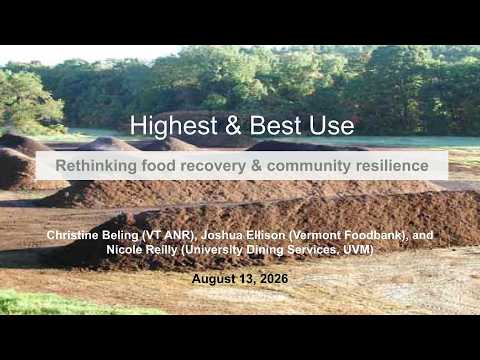
Christine Beling of the Vermont Agency of Natural Resources, Joshua Ellison of the Vermont Foodbank, and Nicole Reilly of University Dining Service at the University of Vermont, will join us for a practical and thoughtful conversation about Vermont’s Food Recovery Hierarchy and how communities, businesses, institutions, farms, and residents can work toward the shared goal of “highest and best use” for food and food residuals.
Rather than focusing on enforcement or compliance, this webinar will explore the Food Recovery Hierarchy as a framework for decision-making, community care, and systems thinking. As more Vermonters rely on the charitable food system and communities face increasing economic and environmental pressures, thoughtful food recovery and organics management practices are becoming more important than ever.
Presenters will discuss updated guidance from the Vermont Departments of Health and Environmental Protection on food donation and connections to food waste prevention, real-world examples and practical strategies from Vermont that will highlight opportunities to improve food recovery, strengthen partnerships and increase access to nutritious food while still ensuring that unavoidable food scraps are returned to the soil through composting.
This webinar is intended for food businesses, institutions, schools, farms, composters, food shelf organizers, municipalities, solid waste professionals, policymakers, and anyone interested in building more resilient and thoughtful food recovery systems.
-
Thursday, September 10 | Noon–1:00 p.m.
Join us for a discussion on the role of biosolids-based manufactured topsoil in land restoration, erosion control, and soil rebuilding projects across the Northeast. This webinar features Charley Hanson of Resource Management, Inc. and Josh Burns of the Vermont DEC Residuals Management & Emerging Contaminants Program.
Manufactured topsoil products created from residual materials such as biosolids, paper fiber, wood ash, and mineral soils are increasingly being used in reclamation projects, roadside stabilization, gravel pit restoration, landscaping, and stormwater applications because of their ability to improve soil structure, water-holding capacity, vegetation establishment, and erosion resistance. Presenters will discuss how these engineered soil blends are produced, tested, regulated, and applied in the field, along with the practical opportunities and challenges associated with their use.
The webinar will also explore broader questions surrounding residuals management in Vermont, including evolving regulatory frameworks, public perception, product quality standards, beneficial reuse, and emerging contaminants such as PFAS. Participants will gain insight into how residual-derived soil products may fit into long-term conversations about circular materials management, climate resilience, and restoring disturbed landscapes while protecting environmental and public health.
This session is intended for composters, wastewater and residuals professionals, engineers, municipalities, landscapers, contractors, soil and stormwater practitioners, regulators, and anyone interested in the future of soil-building materials and residuals management in Vermont. -
Thursday, October 8 | Noon–1:00 p.m.
James McSweeney is a composting consultant, educator, and author of Community-Scale Composting Systems, a comprehensive designer’s and practitioner’s manual for food scrap composters. Through his work at the Highfields Center for Composting and current consultancy, Compost Technical Services, James has worked with hundreds of composters, large and small, on everything from site planning, design, and management to compost heat recovery and livestock feeding systems. He coauthored Growing Local Fertility: A Guide to Community Composting and has been an ardent proponent and collaborator in the community composting movement in the United States. With a background in agroecology and permaculture, restoring ecological integrity to our local farm and food systems is at the heart of James’s work.
-
Thursday, November 12 | Noon–1:00 p.m.
Join the Composting Association of Vermont (CAV) for a wide-ranging conversation with Marsh Hudson-Knapp and Kathy Sollien about source separation, composting, and the cultural choices that shape our communities.
Drawing from decades of local involvement and practical experience, our presenters will reflect on how our relationship with “trash” influences everything from community resilience and environmental stewardship to consumer culture and personal responsibility. This session will explore the importance of composting and local action in building healthier and more connected communities, while also examining how attitudes toward waste have changed over time.
Part storytelling, part reflection, and part call to action, this webinar will invite participants to think more deeply about the systems and habits that generate waste — and the opportunities communities have to create something better. Expect thoughtful discussion grounded in Vermont values, practical experience, humor, and hope.
This session is intended for anyone interested in composting, waste reduction, community resilience, environmental stewardship, and the human stories behind sustainable living.
Registration
Advance registration is required to receive the session link and follow-up materials.
All webinars are free to attend, but we suggest a $10 donation if possible. You can still register for free by putting in $0 when registering. All are welcome!
CAV uses Zeffy to process payments. Zeffy asks payers to cover credit card fees, but this % can also be set to zero.
Recorded webinars


This free webinar series is made possible with support from our sponsors
CAV Black Gold Sponsor
CAV Regenerators
CAV Enhancers
CAV Suporters


Explore the opportunities and challenges of biosolids-based manufactured topsoil with Charley Hanson of Resource Management, Inc. and Josh Burns of Vermont DEC. Learn how residual-derived soil products are made, regulated, and used to rebuild soils, control erosion, restore disturbed landscapes, and support beneficial reuse—while addressing concerns such as product quality and PFAS.
What role could biosolids-based manufactured topsoil play in rebuilding soils, restoring disturbed landscapes, and managing residual materials in Vermont and across the Northeast?
In this webinar, Charley Hanson of Resource Management, Inc. and Josh Burns of the Vermont DEC Residuals Management & Emerging Contaminants Program discuss manufactured topsoil made from residual materials such as biosolids, paper fiber, wood ash, and mineral soils.
The conversation covers how these engineered soil blends are produced, tested, regulated, and used in applications including land reclamation, roadside stabilization, gravel pit restoration, landscaping, erosion control, and stormwater management.
The presenters also explore some of the opportunities and challenges surrounding beneficial reuse of residual materials, including product quality, regulatory oversight, public perception, environmental and public health protections, and emerging contaminants such as PFAS.
This webinar offers a practical look at where residual-derived soil products may fit within broader efforts to rebuild soils, restore disturbed landscapes, improve climate resilience, and advance more circular approaches to materials management.
0:00-2:30 - Natasha Duarte, CAV
2:30-22:09 - Charley Hanson — Resource Management, Inc.
22:09-27:30 - Josh Burns — Vermont DEC Residuals Management & Emerging Contaminants Program
27:30-37:20 - Charley Hanson — Resource Management, Inc
37:20-55:46 - Q&A and discussion