
Soil, Climate & Research
Compost plays a vital role in building healthy soils, improving water retention, and storing carbon—helping farms and communities adapt to increasingly erratic weather patterns. Researchers and practitioners are exploring how different compost applications affect soil biology, nutrient cycling, and greenhouse gas emissions.
Browse the webinars below to learn more about the connections between compost, soil health, and climate.

Many webinars include downloadable resources & links to more information.

VORS 2024 welcomes from CAV and the Director of the VT ANR Climate Action Office, and the State of the State of Organics in Vermont report.
VORS 2024 welcomes from CAV and the Director of the VT ANR Climate Action Office, and the State of the State of Organics in Vermont report.
Video time stamps:
0:00-1:49 Introduction to VORS 2024 (Natasha Duarte, CAV Director)
1:49-6:35 Welcome from CAV (Dan Goossen, CAV President)
6:35-30:35 Welcome from ANR Climate Action Office (Jane Lazorchak, Director)
Download the slide deck (pdf)
Link shared: ClimateChange.vermont.gov/calendar
30:35-1:06:58 State of the State of Organics in Vermont (Emma Stuhl, VT ANR DEC)
Download the slide deck (pdf)

This VORS 2021 webinar discusses traditional thermophilic composting and vermicomposting, two very different systems promoting different microbial communities. The research presented explores potential synergistic nutrient release effects when the two compost types are mixed.
This VORS 2021 webinar discusses traditional thermophilic composting and vermicomposting, two very different systems promoting different microbial communities. Mature thermophilic compost is generally slow to release nutrients and is inexpensive. In contrast vermicompost already has high levels of available nutrients and is about 10 times the price of thermophilic compost. The research presented explores potential synergistic nutrient release effects when the two compost types are mixed.
Speaker and Video time stamps:
Josef Görres, starts at 5:56
Q&A, starts at 50:45

This VORS 2024 presentation highlights the successes of grassroots-led food rescue and explores opportunities for decentralized composting within the urban landscape of Burlington, VT. Both efforts were launched to empower residents to engage with neighborhood food systems and to uplift urban food access solutions that are often overlooked.
This VORS 2024 presentation highlights the successes of grassroots-led food rescue and explores opportunities for decentralized composting within the urban landscape of Burlington, VT. Both efforts were launched to empower residents to engage with neighborhood food systems and to uplift urban food access solutions that are often overlooked.
Presenters:
Sarah Hobson shares the progress of the Food Not Bombs (FNB) network in collaboration with co-op residences in Burlington, as well as the important role local supermarkets played in reducing food loss and upstream waste.
Bo Meisl speaks about the collaborative energy behind a neighborhood composting pilot and outlines scalable opportunities for community composting across urban zoning districts.
John Culpepper provides an overview of technologies that support decentralized composting and discusses the value of producing biologically rich compost to improve soil health.
Video time stamps:
Download the slide deck (pdf)
Resource shared:
Free, open-source community-scale In-vessel composter design from Compost for Good
Recorded webinar from John “An affordable, buildable, easy to operate, commercial rotating drum composter for schools, organizations, and small communities” (VORS 2020)

Now that we know there are different composts for different "jobs" - where do we source the compost and engineered soils needed? Are they available locally? Regionally?
Throughout the Soil Builders program, we've been talking about the connections between compost, soil health, and water quality; different kinds of compost; and best management practices based on different applications.
Now that we know there are different composts for different "jobs" - where do we source the compost and engineered soils needed? Are they available locally? Regionally?
Joined by Mike Carignan or Agresource, Andrew Carpenter of Northern Tilth, Chuck Duprey of Naturcycle and Heather Voisin on VTrans, we
Recapped of Soil Builders program,
Provided an overview of what types of compost & compost-based products are available and how to test material, from the source & in the field, and
Began to identify the missing piece when it comes to increasing use of compost & compost-based products.
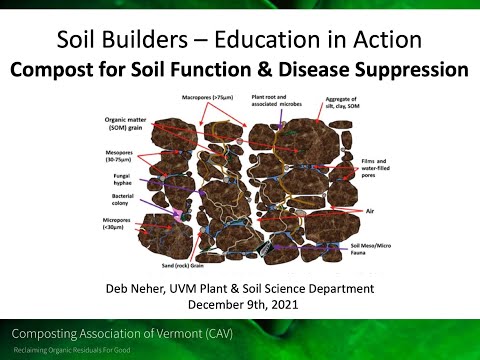
In this webinar, with Deb Neher from the Plant and Soil Science Department at UVM, you'll learn how to manage water infiltration and nutrient availability with compost, why organic matter in compost improves aggregate structure and reduces erosion, and hear about examples of using compost to manage soil borne pathogens of plants.
In this webinar, with Deb Neher from the Plant and Soil Science Department at UVM, you'll learn how to manage water infiltration and nutrient availability with compost, why organic matter in compost improves aggregate structure and reduces erosion, and hear about examples of using compost to manage soil borne pathogens of plants.
Video time stamps:
0:00-2:56 Introduction to Soil Builders Program (Natasha Duarte)
2:56-1:06:13 Compost for Soil Function & Disease Suppression (Deb Neher)
1:06:13-1:25:50 Q&A
Resources shared:
The Composting Handbook, Eds. Robert Rynk, Ginny Black, Jane Gilbert, Johannes Biala, Jean Bonhotal, Mary Schwarz & Leslie Cooperband (2021); Neher, D.A. and Hoitink, H.A. 2021. Compost use for plant disease suppression. Chapter 17
Three books by Jeff Lowenfels:
Teaming with Microbes
Teaming with Nutrients
Teaming with Fungi

In this Soil Builders Module, Chuck Duprey (Naturcycle) and Brian Jerose (Agrilab Technologies Inc.) talk about best management practices (BPMs) for using compost in landscaping and athletic fields, direct erosion control in construction or roadside projects, low nutrient applications, and agriculture.
In this Soil Builders Module, Chuck Duprey (Naturcycle) and Brian Jerose (Agrilab Technologies Inc.) talk about best management practices (BPMs) for using compost in landscaping and athletic fields, direct erosion control in construction or roadside projects, low nutrient applications, and agriculture.
Video time stamps:
0:00-2:30 Introduction to the Soil Builders program (Natasha Duarte)
2:30-9:05 Introduction to BMPs for compost/compost-based products (Chuck Duprey)
9:05-42:15 BMPs in Landscaping and Athletic Fields (Chuck Duprey)
42:15-1:04:30 BMPs for Erosion Control (Chuck Duprey)
1:04:30-1:16:20 BMPs for Low Nutrient Applications (Chuck Duprey)
1:16:20-1:34:07 BMPs for Agricultural Applications (Brian Jerose)
1:34:07-1:44:35 Wrap up and Q&A (Natasha Duarte)
Resources shared:
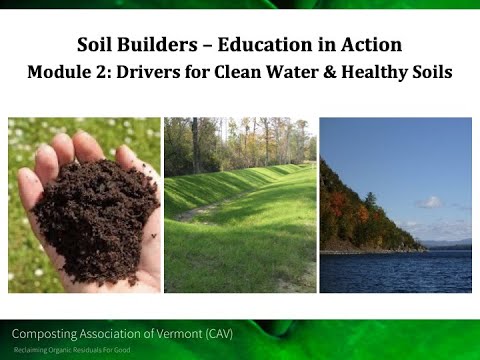
In this module of the Soil Builders program, Elly Ventura (formerly with Lamoille Regional Solid Waste Management District) and Natasha Duarte (Composting Association of Vermont) talk about the drivers for clean water & healthy soils, and how compost can support these goals.
In this module of the Soil Builders program, Elly Ventura (formerly with Lamoille Regional Solid Waste Management District) and Natasha Duarte (Composting Association of Vermont) talk about the drivers for clean water & healthy soils, and how compost can support these goals.
Video time stamps:
0:00-3:00 Introduction (Natasha Duarte)
3:00-11:10 Background (Elly Ventura)
11:10-17:15 Vermont Initiatives (Natasha Duarte)
17:15-22:35 The Compost Connection (Elly Ventura)
22:35-23:21 Conclusion (Natasha Duarte)
Resources shared:
Recycling, Waste Characterization, Food Waste:
Food Waste:
Organics Diversion/Composting:
Vermont Clean Water Initiative/Act 64

In this Soil Builders Module, Marc Companion (Lake Champlain Sea Grant) and Athena Lee Bradley (Organics Consultant) explore the connections between soil health and water quality.
In this Soil Builders Module, Marc Companion (Lake Champlain Sea Grant) and Athena Lee Bradley (Organics Consultant) explore the connections between soil health and water quality.
Video time stamps:
0:00-3:56 Introduction (Natasha Duarte)
3:56-19:16 Stormwater, Healthy Ecosystems & Soil (Marc Companion)
19:16-34:45 Compost, Soil Health & Water Quality (Athena Lee Bradley)
34:45-38:16 Compost-based Best Management Practices (Natasha Duarte)
38:16-55:51 Q&A
Resources shared:
Slide deck from webinar (pdf)
Soil Health: Soil Physical Properties video from Penn State Extension (shown during the webinar)

This is a recording of the VORS 2021 Keynote from David Montgomery titled Bringing Our Soil Back to Life.
This is a recording of the VORS 2021 Keynote from David Montgomery titled Bringing Our Soil Back to Life.
Video time stamps:
Keynote from David Montgomery starts at 2:30
Q&A starts at 56:45
What does it mean to pay farmers and other land stewards for ecosystem services like nutrient cycling, climate regulation, and pollination? This VORS 2022 session shared the latest activity from the Vermont's Soil Health & Payment for Ecosystem Services Working Group.
What does it mean to pay farmers and other land stewards for ecosystem services like nutrient cycling, climate regulation, and pollination? Which services do we value, whom do we pay for them, and for how long? These are some of the questions Vermont's Soil Health & Payment for Ecosystem Services Working Group has been grappling with since 2019. With recommendations due to the legislature in January 2023, the Working Group will spend the remainder of this year developing a pilot program.
This VORS 2022 session shared the latest activity from this Working Group and invited questions and suggestions to inform the outcomes!
Presenters:
00:00 VORS introduction, Natasha Duarte
05:12 Maddie Kempner, Northeast Organic Farming Association of Vermont
25:13 Discussion break
32:03 Maddie Kempner, Northeast Organic Farming Association of Vermont
51:28 Q&A and discussion
Shared resources:

Curious how composting can help reduce the impacts of climate change? This panelists in this VORS 2022 session talked about the relationship between greenhouse gas (GHG) emissions, carbon sequestration and compost use and helped quantify carbon sequestration and other climate-related benefits of composting.
Curious how composting can help reduce the impacts of climate change? This panelists in this VORS 2022 session talked about the relationship between greenhouse gas (GHG) emissions, carbon sequestration and compost use and helped quantify carbon sequestration and other climate-related benefits of composting.
After providing an overview of current regenerative agriculture programs, they assessed the practical application of the Climate Action Reserve’s Soil Enrichment Protocol. This protocol uses compost soil amendments for the generation and marketing of Voluntary Emissions Credits. The panelists discussed the strengths and gaps in the current protocol and looked at how future research investments could offset credits through compost amendments for soil GHG emissions capture.
Presenters and Video time stamps:
00:00 Introduction by Natasha Duarte
05:00 Sally Brown, University of Washington
25:57 Gordon Hilbun, One Earth Fund
50:20 Andrew Carpenter, Northern Tilth, LLC
Shared resources:
VORS 2021 Keynote presentation from David Montgomery

In this VORS 2023 session, Compost for Good's Jenn Perry presented a summary of their work supporting farmers interested in improving soil health, reducing the need for expensive chemical inputs, offering a community service, and increasing on-farm income.
In this VORS 2023 session, Compost for Good's Jenn Perry presented a summary of their work supporting farmers interested in improving soil health, reducing the need for expensive chemical inputs, offering a community service, and increasing on-farm income. She focused on microscopy as a soil health tool, the implications of biologically rich soil, and opportunities to enrich soil health through extracts and teas.
Presenter: Jenn Perry, Compost for Good
Video time stamps:
00:00 VORS introduction from Natasha Duarte
01:11 Jenn Perry, Compost for Good
55:24 Q&A
59:27 Microscopy video
Download the Maximizing the value of compost slide deck (pdf)
Resources shared:
John and Katie Culpepper’s webinar, An affordable, buildable, easy to operate, commercial rotating drum composter for schools, organizations, and small communities, was referenced

This VORS 2024 presentation traces the major shifts in soil management practices that led to regenerative agriculture and highlight new soil science research, including rhizophagy, quorum sensing and theories of plant/microbe communications. NRCS soil health principles are also reviewed.
This VORS 2024 presentation traces the major shifts in soil management practices that led to regenerative agriculture and highlight new soil science research, including rhizophagy, quorum sensing and theories of plant/microbe communications. NRCS soil health principles are also reviewed.
Presenter: Robert Kurth, Master Gardener
Video time stamps:
Download the slide deck (pdf)
Resources shared:
The Five Principles of Soil Health - Interview at Groundswell 2019, Jay Fuhrer
Soil Health: Principle 1 of 5 – Soil Armor, Jay Fuhrer, NRCS Soil Health Specialist
Soil Health: Principle 2 of 5 – Minimizing Soil Disturbance, Jay Fuhrer, NRCS Soil Health Specialist
Soil Health: Principle 3 of 5 – Plant Diversity, Jay Fuhrer, NRCS Soil Health Specialist
Soil Health: Principle 4 of 5 – Continual Live Plant/Root, Jay Fuhrer, NRCS Soil Health Specialist
“Soil Health … Our shared journey”, Jay Fuhrer
“Quorum Sensing In The Soil Microbiome”, Dr. Christine Jones
“Extracts & Slurries - Compost Tea - RegenerateLA Training Series 1 | Part 21”, Nicole Masters
“Biopriming Seed Treatment”, Nicole Masters
“Microbial diversity and root exudates as an important facet in the rhizosphere ecosystem” (Abstract)
“The Four Stages of Plant Health”, John Kempf
“Rhizophagy Cycle: An Oxidative Process in Plants for Nutrient Extraction from Symbiotic Microbes”, Dr. John White, et.al

In this VORS 2024 in-person session, a panel of policy drivers, producers, researchers, and practitioners shared their perspectives in a forward-leaning discussion amongst participants exploring compost production and its capacity for increasing ecosystem resiliency.
From enhancing soil health and improving water quality to reducing the use of fertilizers and pesticides while minimizing landfill gas emissions, compost is a vital and unique tool in mitigating the effects of climate change.
In this VORS 2024 in-person session, a panel of policy drivers, producers, researchers, and practitioners shared their perspectives in a forward-leaning discussion amongst participants exploring compost production and its capacity for increasing ecosystem resiliency.
Starting with a foundational overview of composting programs and technologies ranging from small-scale operations at schools and farms to large permitted solid waste facilities, this session focused on connecting compost with climate resilience. Panelists introduced topics such as teaching climate resilience through community-level compost programs, the value of compost in carbon sequestration, and using compost-based agricultural practices to augment soil health. Some recent data and ongoing research was presented providing a baseline for the direction and scope of future investigations and analysis.
Through this session, we aimed to expand our collective understanding of compost production in Vermont and its value in fortifying our ecosystems given intensifying weather events and supporting strong and sustainable crop, fiber, and livestock yields. We encouraged participants to imagine creative, comprehensive, and continuous improvements in understanding compost for the climate.
Moderator: Susan Alexander, Lamoille Soil
Panelists:
Cat Buxton, Grow more, Waste Less
Josh Faulkner: UVM Center for Sustainable Agriculture, Farming and Climate Change program
Brian Jerose, Agrilab Technologies Inc.
Mari Omland, Green Mountain Girls Farm
Ryan Patch, Vermont Agency of Agriculture, Food and Markets
Alissa White, American Farmland Trust
Restoring soils on a regional scale requires a systems approach supported by the community. This workshop covers examples and ideas of how organizations, farmers, schools, conservation districts, conservation commissions and others can all work together to share best practices, interventions, trials, errors, and success stories. Part presentation, part conversation, we explore our ability to leverage organics recycling, composting, and other initiatives to cultivate the foundation for healthy soils, food systems, waterways and communities.
Presenters:
Karen Ganey, White River Natural Resources Conservation District
Jaiel Pulskamp, White River Natural Resources Conservation District
Download slidedeck pdf