
Compost Systems & Technologies
Explore a wide range of composting approaches and innovations through our collection of recorded webinars and resources. From backyard and community composting to more advanced municipal, commercial, and on-farm systems, these resources highlight practical strategies, tools, and technologies shaping organics recycling.
Learn about specialized techniques such as Johnson-Su composting, vermicomposting, poultry foraging and eco-sanitation systems—including composting toilets and urine reclamation.
We’ve also included anaerobic digestion in this section as a related organic materials management system.

Many webinars include downloadable resources and links to more information.
Food Scrap Composting Successes
Composting systems come in all shapes and sizes. This VORS 2021 webinar provides an overview of these different types of operations, including information about permit size (or exemption); accepted materials; recipe development and sourcing; hauler relations; customer training; marketing; and more. Through the discussion you’ll learn about advantages or disadvantages to advancing to the next permit level; systems and process improvements; relationship building; as well as the challenges and opportunities that come with different scale and system choices.
Panelists and Video time stamps:
Athena Lee Bradley, Community scale composting, starts at 5:26
Eric Paris, On-farm composting, starts at 10:20
Bob Spencer, Small permitted facility, starts at 21:54
Trevor Mance, Medium permitted facility, starts at 32:28
Kim Stacey, Large permitted facility, starts at 47:29
Q&A starts at 1:02:47
Recorded webinars related to backyard and community composting

In this webinar, you'll learn how to compost successfully - whether you're starting for the first time, or are a compost veteran. We'll also review Vermont's food scrap ban from the landfill, and other options for managing food scraps in addition to home composting.
In this webinar, you'll learn how to compost successfully - whether you're starting for the first time, or are a compost veteran. We'll cover cold composting, as well as active and passive management techniques. You'll leave with strategies for jump-starting an old pile, keeping smells down and animals out, and how to compost safely during this time of COVID-19.
We'll also review Vermont's food scrap ban from the landfill, and other options for managing food scraps in addition to home composting.
This webinar was part of CAV’s 2020 ICAW Program.
Presenters:
Cassandra Hemenway, Central Vermont Solid Waste Management District
Theron Lay-Sleeper, Central Vermont Solid Waste Management District
Resources shared:
Dirt on Composting Guidebook (CVSWMD)

This VORS 2024 presentation highlights the successes of grassroots-led food rescue and explores opportunities for decentralized composting within the urban landscape of Burlington, VT. Both efforts were launched to empower residents to engage with neighborhood food systems and to uplift urban food access solutions that are often overlooked.
This VORS 2024 presentation highlights the successes of grassroots-led food rescue and explores opportunities for decentralized composting within the urban landscape of Burlington, VT. Both efforts were launched to empower residents to engage with neighborhood food systems and to uplift urban food access solutions that are often overlooked.
Presenters:
Sarah Hobson shares the progress of the Food Not Bombs (FNB) network in collaboration with co-op residences in Burlington, as well as the important role local supermarkets played in reducing food loss and upstream waste.
Bo Meisl speaks about the collaborative energy behind a neighborhood composting pilot and outlines scalable opportunities for community composting across urban zoning districts.
John Culpepper provides an overview of technologies that support decentralized composting and discusses the value of producing biologically rich compost to improve soil health.
Video time stamps:
Download the slide deck (pdf)
Resource shared:
Free, open-source community-scale In-vessel composter design from Compost for Good
Recorded webinar from John “An affordable, buildable, easy to operate, commercial rotating drum composter for schools, organizations, and small communities” (VORS 2020)
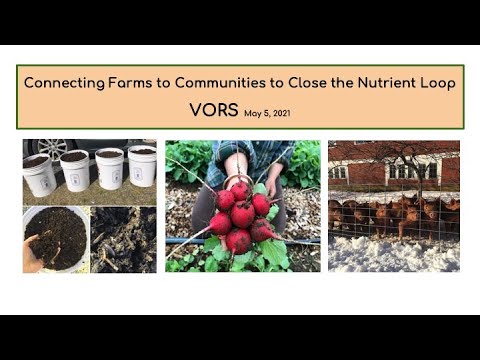
This VORS 2021 session introduces On-Farm Composting Project of the Farm to Plate Food Cycle Coalition and the resulting On-Farm Composting Booklet.
This VORS 2021 session introduces On-Farm Composting Project of the Farm to Plate Food Cycle Coalition and the resulting On-Farm Composting Booklet. The On-Farm Composting Booklet outlines regulations around composting, lays out how communities can connect to close the nutrient loop, and provides a matrix to help readers understand the regulatory thresholds aligned with compost volumes and methods of composting available. Three case studies in Vermont are highlighted to show different adaptations of closing the nutrient loop at a community scale.
Presenters and Video time stamps:
Natasha Duarte, starts at 3:33
Cat Buxton, starts at 11:05
Panel discussion with Jen Murphy and Chuck Wooster, starts at 20:52
Q&A, starts at 41:54

Backyard composting is a fundamental tool to help Vermonters manage their household food waste and comply with the Universal Recycling and Composting Law while creating a beneficial soil amendment. This VORS 2024 workshop aims to increase your confidence in backyard composting and also provides tips for trainers to use in their own community outreach efforts.
Backyard composting is a fundamental tool to help Vermonters manage their household food waste and comply with the Universal Recycling and Composting Law while creating a beneficial soil amendment. Recent studies by UVM demonstrate that nearly half of Vermonters compost in their yard or with neighbors, but many still feel they need more information on how to compost correctly, how to compost in winter, and what materials to purchase.
This VORS 2024 workshop aims to increase your confidence in backyard composting and also provides tips for trainers to use in their own community outreach efforts.
Instructor: Shannon Choquette
Video time stamps:
04:17-28:43 Background on VT's organic diversion law, compost and climate change connections, and the importance of reducing food waste, by Shannon Choquette, VT ANR
28:43-01:15:01 Backyard composting, by Shannon Choquette, VT ANR
Download the slide deck (pdf)
Recorded webinars related to larger composting systems

This VORS 2023 presentation describes the planning and design process to integrate compost aeration and heat recovery (CAHR) in order to increase the space and labor efficiency of operations on a limited footprint.
Windham Solid Waste Management District (WSWMD) has operated a composting facility using turned windrow methods since 2012. The site manages source-separated food scraps, food processing residuals, leaves, wood chips, and other feedstocks, and sells screened compost as “Brattlegrow.” The site needs to expand its capacity to meet the increased volume of food scraps following the implementation of Act 148, and change its status from a small certified facility to a permitted medium-scale composting facility.
This VORS 2023 presentation describes the planning and design process to integrate compost aeration and heat recovery (CAHR) in order to increase the space and labor efficiency of operations on a limited footprint. The regulatory, design, planning, fundraising, and other development work to identify an economical infrastructure and operating plan are also discussed.
Presenters and Video time stamps:
00:00 VORS introduction from Natasha Duarte
03:37 Robert Spencer, WSWMD
17:03 Brian Jerose, Agrilab Technologies Inc.
38:49 Robert Spencer, WSWMD
46:08 Q&A
Download the Expanding site capacity slide deck (pdf)

On-farm composting can look different from farm to farm, taking place at various scales and with different objectives. This VORS 2024 session is a deep dive into the importance of providing tailored assistance for farmers seeking to elevate their composting practices.
On-farm composting can look different from farm to farm, taking place at various scales and with different objectives. This VORS 2024 session is a deep dive into the importance of providing tailored assistance for farmers seeking to elevate their composting practices.
Andrew and Natasha share their experiences navigating this intricate landscape, addressing cultural and technical nuances. Gain insights into approaches that make assistance accessible and impactful, whether you're just starting or a seasoned technical service provider. Both presenters share inspiring stories of on-farm composting success that contribute to the resilience of both agricultural ecosystems and communities.
Presenters and Video time stamps:
40:58-01:17:07 Natasha Duarte, Composting Association of Vermont
Download the slide deck (pdf)
Check out CAV’s On-Farm Composting Toolkit

Learn about CAV's on-farm composting project and hear from two of their farmer partners in this VORS 2023 session.
CAV's on-farm composting project offers participating farms and communities a cost-effective solution for diverting food and organic waste to composting, significantly benefiting farmers and community members. These benefits include diverting food scraps from landfills, producing compost for on-farm use, helping to spark more interest in healthy soils, reducing the use of fertilizers, and - in some cases - reducing food insecurity.
Additionally, it helps create a more "waste-aware" culture through local management, diversion, and composting of food scraps & other organic materials, increasing the adoption of creative food recovery to benefit communities & build resiliency.
Listen in to hear from some of our partner farmers and learn how to get involved!
Panelists:
Athena Lee Bradley, independent consultant
Cat Buxton, Grow More, Waste Less
Natasha Duarte, Composting Association of Vermont
Liz Freierman, Highwater Farm
Dan Kilrain, Work Song Farm
Ben Tipton, Firefly Farm
Video time stamps:
00:00 Welcome to VORS 2023 from Natasha Duarte
01:53 Introduction to the project, Natasha Duarte
05:28 Partner Farmers share their stories
29:14 On-farm Composting Toolkit
31:26 Q&A
Download the On-farm Community-Oriented Food Scrap Composting slide deck (pdf)
Resources shared:
Example of an online compost recipe calculator (there are many freely available)
USDA Rural Development Solid Waste Management Grant Program (VT link)

This VORS 2023 webinar features the Vermont Agency of Agriculture, Food, and Markets (VAAFM), what they've seen and potential strategies to mitigate concerns about composting food scraps on farms.
There are challenges - and solutions - when importing food residuals on to farms for composting. In this VORS 2023 session the Vermont Agency of Agriculture, Food, and Markets (VAAFM) shares what they've seen and potential strategies to mitigate concerns.
They provide information on the water quality standards required to comply with the Require Agricultural Practices Rules and a status update on rulemaking endeavors about on-farm composting.
Panelists:
Steve Cash, VAAFM
Stephanie Smith, VAAFM
Zach Szczukowski, VAAFM
Video time stamps:
00:00 VORS introduction from Natasha Duarte
04:15 Zach Szczukowski, VAAFM
30:34 Q&A
Download the Agricultural Food Residuals Management slide deck (pdf)
Resources referenced:

In this VORS 2023 session, Tom Akin, an NRCS Agronomist in the Colchester NRCS office, shared information about some of the composting projects recently completed with NRCS assistance and some of the opportunities available to Vermont’s farmers interested in composting.
The USDA’s Natural Resources Conservation Service (NRCS) provides technical and financial assistance to agricultural producers and landowners who are interested in implementing voluntary conservation on their farms and forests.
In this VORS 2023 session, Tom Akin, an NRCS Agronomist in the Colchester NRCS office, gave a short presentation on some of the composting projects recently completed with NRCS assistance and some of the opportunities available to Vermont’s farmers interested in composting.
Presenter: Tom Akin, NRCS
Video time stamps:
00:00 Welcome to VORS 2023 from Natasha Duarte
02:33 Tom Akin, NRCS
44:20 Q&A
Download the NRCS programs slide deck (pdf)
Resources shared:
VT NRCS Regional Conservation Partnership Program (RCPP) Projects
Electronic Field Office Technical Guide (eFOTG)
Section 4 has conservation practice technical information
Section 2 has state-wide VT soils information
Wood Chips for the Land, (Soil Conservation Service Leaflet 323)

This VORS 2022 session provided an overview of eligibility requirements and standards of operation for on-farm composting, as well as insight into other policies that inform the regulation of these operations, including commercial feed and management of invasive pests.
Under Act 41, the Agency of Agriculture regulates certain on-farm compost operations by setting standards for registration, management, and design.
This VORS 2022 session provided an overview of eligibility requirements and standards of operation, as well as insight into other policies that inform the regulation of these operations, including commercial feed and management of invasive pests.
Presenters and Video time stamps:
00:00 Introduction, Natasha Duarte
01:25 On-Farm Composting, Stephanie Smith, Vermont Agency of Agriculture Food & Markets
43:11 Invasive Worms, Emilie Inoue, Vermont Agency of Agriculture Food & Markets
Shared resources:
VT Act 148 (Universal Recycling Law)
VT Act 41 (An act relating to the regulation of agricultural inputs for farming)
VT Act 709 (An act relating to miscellaneous agricultural subjects)
Recommendations [on preventing spread of invasive worms] for plant sales from the University of Wisconsin
This VORS 2021 session introduces On-Farm Composting Project of the Farm to Plate Food Cycle Coalition and the resulting On-Farm Composting Booklet.
This VORS 2021 session introduces On-Farm Composting Project of the Farm to Plate Food Cycle Coalition and the resulting On-Farm Composting Booklet. The On-Farm Composting Booklet outlines regulations around composting, lays out how communities can connect to close the nutrient loop, and provides a matrix to help readers understand the regulatory thresholds aligned with compost volumes and methods of composting available. Three case studies in Vermont are highlighted to show different adaptations of closing the nutrient loop at a community scale.
Presenters and Video time stamps:
Natasha Duarte, starts at 3:33
Cat Buxton, starts at 11:05
Panel discussion with Jen Murphy and Chuck Wooster, starts at 20:52
Q&A, starts at 41:54

This VORS 2021 webinar highlights the work of Agrilab Technologies Inc. (AGT), one of the teams funded through the VT Phosphorus Innovation Challenge. AGT is setting up a network of on-farm composting and P processing sites to stabilize and add value to P concentrates and other biomass.
This VORS 2021 webinar highlights the work of Agrilab Technologies Inc. (AGT), one of the teams funded through the VT Phosphorus Innovation Challenge. The larger effort seeks to reduce P loading to Lake Champlain and other VT waters through new practices.
AGT is setting up a network of on-farm composting and P processing sites to stabilize and add value to P concentrates and other biomass. End products are intended to be better distributed and applied within farm operations, within watersheds and for export. Use of compost aeration and heat recovery (CAHR) units aids with efficient compost operations and drying/stabilization of finished products.
Speakers and Video time stamps:
Kaitlin Hayes, starts at 4:04
Brian Jerose, starts at 11:09
Q&A, starts at 1:01:37

This virtual tour of Black Dirt Farm, a diversified family farm in Vermont's Northeast Kingdom, was part of VORS 2021.
This virtual tour of Black Dirt Farm, a diversified family farm in Vermont's Northeast Kingdom, was part of VORS 2021.
Black Dirt Farm collects food scraps from a wide variety of businesses and institutions in their community/ region, and uses that material as a component of the compost forage it produces for its 1,000 bird flock of laying hens. What isn't consumed by the birds is then used to make compost and worm castings. The farm also grows a small number of crops.
Their farm is firmly based in regenerative agricultural practices and the creation of sustainable food systems. Black Dirt Farm is committed to a community-scale, systems-based approach to organics management. Tom has played a wide variety of roles in the agricultural and composting sectors for 25 years.
Video time stamps:
The tour starts at 3:43
Q&A with Tom Gilbert starts at 16:07

This virtual tour of Windham Solid Waste Management District's food scrap composting facility was part of VORS 2021.
This virtual tour of Windham Solid Waste Management District's food scrap composting facility was part of VORS 2021.
Windham Solid Waste Management District's food scrap composting facility has grown to the 2nd largest in VT. The tour shows the processing of Brattleboro's residential curbside organics, as well as commercial and industrial organics co-collected with non-recyclable paper and cardboard.
The facility has met its annual "small food waste composting facility" permit capacity limit of 2,000 cubic yards, and the regulatory requirements for moving to a larger permit capacity will be discussed. Marketing of "Brattlegrow" compost will be described, including manufacturing of topsoil..
District Manager, Bob Spencer, was also a panelist in the session on Food Scrap Composting Success: Stories from the Field. In this session Bob discusses the District’s compost facility and the follow up Q&A.

This virtual tour of Chittenden Solid Waste District’s Organic Diversion Facility (formerly known as Green Mountain Compost) was part of VORS 2021.
This virtual tour of Chittenden Solid Waste District’s Organic Diversion Facility (formerly known as Green Mountain Compost) was part of VORS 2021.
Located within Vermont’s most densely populated area, Chittenden Solid Waste District’s Organic Diversion Facility has been ramping up to meet the changing needs of organics diversion. Come along for a virtual ride as we explore the many recent upgrades and process changes along with some of the challenges that increased organics diversion brings with it.
Video time stamps:
The tour starts at 0:12
Q&A with Dan Goossen starts at 15:47

In this VORS 2021 webinar, CSWD’s Rhonda Mace provides an overview of the food scrap management landscape in Chittenden County. Rhonda shares where to find more information about each option and gives an overview of current licensed food scrap haulers in Chittenden County. CSWD's Michele Morris rounds out the session by moderating Q&A.
In this VORS 2021 webinar, CSWD’s Rhonda Mace provides an overview of the food scrap management landscape in Chittenden County. She touches on the myriad options for how Chittenden County residents and businesses can comply with the food scrap diversion requirements of VT’s Universal Recycling Law (Act 148), including: food recovery/waste prevention, onsite management (garbage disposals, grinders, dehydrators, backyard and community-scale composting and digesting), feeding animals, drop-off options, curbside pickup, and - importantly - where those organics may end up depending on the option chosen.
Rhonda shares where to find more information about each option and gives an overview of current licensed food scrap haulers in Chittenden County. CSWD's Michele Morris rounds out the session by moderating Q&A.
Presenters and Video time stamps:
Rhonda Mace, starts at 3:35
Q&A moderated by Michele Morris, starts at 43:27

Municipal composting programs are continuously evolving to address challenges and expand capacity. This VORS 2025 session will feature updates from two solid waste management districts tackling key issues in organics recycling.
Municipal composting programs are continuously evolving to address challenges and expand capacity. This VORS 2025 session will feature updates from two solid waste management districts tackling key issues in organics recycling.
Chittenden Solid Waste District’s Organics Recycling Facility will share strategies for controlling contamination in municipal composting, including policy development, equipment solutions, and communication tactics to improve hauler compliance and overall program success.
Windham Solid Waste Management District will provide an inside look at the planning, funding, and construction of their new compost aeration system, designed to increase processing capacity and efficiency. Join this session to learn from real-world experiences, gain insights into innovative solutions, and explore the future of municipal composting operations.
Facilitator: Alyssa Eiklor, ANR/DEC
Panelists and Video time stamps:
0:00-38:00 Kim Stacey and Allison Smith, Chittenden Solid Waste District-Organics Recycling Facility
Strategies for Contamination Control in Modern Municipal Composting
Join Chittenden Solid Waste District’s Organic Recycling Facility home of Green Mountain Compost in covering one of the most persistent challenges in composting: contamination. Topics to be covered include: the process of building, implementing, troubleshooting a new contamination policy; innovative equipment solutions for efficiency; communication strategies to improve relationships and compliance with haulers and a refreshed dedication to curbing an industry wide problem grounded in collaboration, transparency, and continuous improvement. GMC’s efforts have yielded early results, but challenges remain. This session will share practical strategies and lessons learned in a large-scale municipal facility.
38:00-1:30:39 Brian Jerose, Agrilab Technologies Inc. and Robert Spencer, Windham Solid Waste Management District
Installation of a compost aeration system at Windham Solid Waste Management District
WSWMD serves 17 member municipalities in southeastern Vermont, and operates a recycling center, transfer station and composting facility in Brattleboro. Growth of the food scraps and other residuals collected and composted at the site required the district to obtain a new state permit for more capacity, and invest in facility infrastructure. With funding from the district board, the state of Vermont and the USDA Rural Development Community Facilities program, site work began in October 2024 and is nearing completion as of this submission. The presentation will document the phases of design and development, construction, implementation and pending start-up of the compost aeration facility.
Recorded webinars related to other types of composting systems
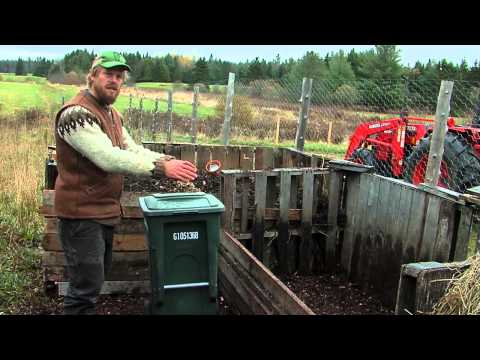
You can your wean your chickens off grain and produce more nutritious eggs by feeding your chickens on food scraps and compost. This video talks you through the things to think about in order to feed food scraps to your chickens effectively.
Systems to feed laying hens food scraps in commercial operations are still evolving. Generally, a farm’s set-up reflects the scale of the operation and the role of food scraps in the feed ration.
Feeding
Some operators feed their hens exclusively on food scraps, compost, and pasture with mineral supplements, while others offset a portion (5-50%) of their purchased feed with food scraps. In Vermont, when this practice is occurring with flocks over 40 birds, the food scraps are typically imported from surrounding communities.
Experience from two laying operations where food scraps and compost are 100% of the feed ration suggests that providing 2 pounds of food scraps per day works well. It appears hens will eat up to 1.5 pounds of food scraps daily, however not all of the food scraps provided will be desirable or edible to the hens. Therefore, modestly over-budgeting the food scrap amounts is advisable and supports the hens’ ability to fill themselves while using discretion about what they choose to eat.
Sourcing Food Scraps
Typically food scraps are captured from grocers, restaurants, schools and colleges, hospitals, residents (through drop off programs at recycling centers), prisons, corporate and state cafeterias, resorts, food processors, brewers, distillers, and other food-based businesses and institutions. Collection systems range in scale and mechanization. Some farms do not haul food scraps and receive loads from commercial or municipal haulers, while others self-collect using methods including small containers (5-32-gal) in the back of a pick up truck, medium size containers (32-48 gal) on a flatbed trailer, or larger containers (48-64 gal) with mechanical systems for tipping containers into a dump trailer or truck. Where small and medium sized containers are collected and food scraps are transported in the container, operators exchange clean containers (requiring extra containers) for full ones, while operators tipping containers into a truck or trailer carry onboard washing systems and clean containers on-site once they have been tipped. These systems carry their own water and collect wash water in with the food scraps.
Handling and Feeding Food Scraps
Handling and feeding food scraps requires good infrastructure and husbandry. Like other aspects of one’s farm operation, the handling and feeding food scraps system must work reliably and every day. Therefore the parts of the system need to function under all potential circumstances. For example, predictable access to the tipping location throughout the year is critical. Useful features of food scrap feeding infrastructure include:
Access Road(s) – Stable road surfaces and plenty of turning radius.
Tipping Dock – In most cases the operator will benefit from having an elevated platform for tipping loads into a receiving or feeding bin.
Feeding System – This is an organized, contained, and manageable system to feed materials with adequate access for tipping loads, blending materials, and removing contents. These systems can be mobile or static and can be designed to support feeding food scraps alone or in a compost blend. A Feeding Bin can be useful in giving hens contained access while providing equipment with a place to blend materials and push walls for easy removal. Covering the feeding area will increase hen foraging in inclement weather, keep mix drier, and prevent snow from accumulating on the food scraps.
Compost Management System – Under most scenarios there will be residual food scraps that the hens don’t eat. If the food scraps have not already been blended with a carbon material to support composting, the residuals will need to be combined with dry matter and carbon. Either way this system will result in a combination of uneaten food and other organic materials requiring management. The operator will need a place sufficiently large and easily accessible to actively manage this composting process. This can be within or outside of the feeding system.
The primary and obvious difference in handling food scraps as opposed to grain is the moisture content and putridity of the food scraps. As a result of this high moisture, ‘ready-to-rot’ condition, food scraps have the potential to cause odors, create environmental pollutants, attract rodents, skunks and other unwanted critters, and potentially, create poor animal health conditions. Additionally, moisture content makes food scraps prone to freezing in cold temperatures, making the food unavailable to hens for eating.
By integrating the feeding of food scraps into a composting strategy the operator can mitigate these concerns, while also gaining other benefits. The composting process requires blending the food scraps with other organic materials, of which a good portion must be dry carbon material to support active composting. This requires that the operator secure these other materials proportionately to the amount of food scraps they anticipate handling. When these materials are blended they create the conditions to support exponential growth in the beneficial microbial population, especially bacteria. This process mitigates odor creation, leachate, colonization by pathogenic organisms, and produces heat that keeps the materials from freezing. In some cases the feeding pile remains free of snow. Additionally, there is reason to believe that by culturing microbes in the food scraps we can increase the protein available to the hens and gain other health benefits associated with grazing birds. In order to support these conditions, the handling system must lend itself to passive pile aeration, blending and rolling, and operator management.
Economic Benefits
As noted earlier, one of the clearest benefits of feeding food scraps to laying hens is reduced feed cost. The range of savings on feed depends on whether the grain is bulk or retail, conventional or organic. Another economic benefit is potential new revenue from tipping fees (a fee paid to the farmer by the hauler who delivers the food scraps). In scenarios where producers receive a tipping fee for accepting food scraps, the operator is able to turn feed from a large cost to a modest income. In addition, like pastured or organic eggs, there may be a marketing opportunity for eggs produced by a method that uses of a locally available resource – food scraps – instead of imported feed. Additionally, if current and future research reveals nutritional attributes of the eggs similar to pasture raised layers, the health benefits will become a strength in creating additional value.
Labor
The trade off from reduced feed costs with this system is higher and different labor costs. Adequate scale and facility development can reduce labor demands significantly, though initial capital costs will increase. Mechanizing the tote handling and washing system provides dramatic reductions in labor costs per ton of food scraps handled. Covered feeding areas with adequate space for managing several weeks of food scraps in one place will reduce snow management and materials movement (food scraps, and especially food scraps blended into a compost mix will reduce in volume over time).
Pathogens
While farmers have been feeding food scraps to laying hens for hundreds, if not thousands, of years, the resurgence of this practice for commercial flocks has raised issues about potential pathogen pathways. Current research (scheduled for release in late 2015) has narrowed down that concern, with Salmonella Entridis the pathogen of most concern. The concern is that s. Entridis could be brought into the laying operation and hen exposure in feed could result in the vertical transmission into eggs. From the testing already conducted on three farms (including one not following best practices) researchers have not identified elevated levels of pathogens.
To mitigate pathogen concerns, feeding food scraps in a composting system enables the producer to grow out a dynamic bacterial and fungal food web that will prevent bacteria of concern from reaching pathogenic levels (due to resource competition for the most part). While questions remain about how to best manage this integration and optimize pathogen management, adequate literature exists to substantiate the efficacy of composting systems in destroying and managing pathogen colonies. Since hens are benefiting from this microbial diversity and abundance year round, there may in turn be animal health benefits we do not yet fully understand.
Advancing the Practice
A Northeast Sustainable Agriculture, Research and Education (NE SARE) grant supported a collaborative research project between Black Dirt Farm (Stannard, VT), Cornell University, University of Connecticut and two participating farms in central and northern Vermont to further assess aspects of this practice as discussed here. (Results available after January 2016) Further research and documentation is needed to advance this practice, and fully leverage the opportunity presented by State legislation banning discarded food from the landfill.
Text provided by Tom Gilbert, Black Dirt Farm, Stannard, VT, USDA/SARE grant recipient, 2014
Additional Links and Resources
Layer Flock Budget Worksheet (from Intervale) (.XLS format)
__
This resource is content originally developed by the Highfields Center for Composting in Hardwick VT. The Highfields Center for Composting dissolved as an organization in December 2014 and ended its active involvement in the Close the Loop Program. The content has been made publicly available for use in supporting organics management in Vermont and elsewhere through the generosity of the High Meadows Fund, the Harris and Frances Block Foundation, and the Vermont Community Foundation. The Vermont community wishes to thank the Highfields Center for Composting for its years of outstanding leadership in the service of community composting and universal recycling in Vermont.

On Thursday, October 26th, 2023, members of the Vermont Ecological Sanitation Coalition joined CAV for a conversation about the environmental and societal benefits of ecological sanitation for Vermont, the safety of humanure composting, and current regulatory options.
On Thursday, October 26th, members of the Vermont Ecological Sanitation Coalition joined CAV for a conversation about the environmental and societal benefits of ecological sanitation for Vermont, the safety of humanure composting, and current regulatory options.
We addressed misconceptions about compost toilet systems, shared some best practices, and discussed the possibility of CAV developing training for successfully using these systems.
Video time stamps:
0:00 Introduction to the session and guests
3:23 What is the Vermont Ecological Sanitation Coalition & why does it exist
6:45 What are compost toilet systems
17:59 Discussion about misconceptions, research, and testing
37:18 General discussion
Shared resources
A summary of the regulatory landscape & a link to last year’s bills is under “Compost Toilets” on Rich Earth Institute’s website.
Please fill out this survey to let us know your thoughts so that we can gauge interest in this topic.

This is a video of the VORS 2024 hands-on workshop with Jim Stiles, that involved emptying and examining the contents of a mini Johnson-Su reactor to assess its progress. Participants were encouraged to participate in this examination and share observations.
Jim Stiles has been experimenting with producing Johnson-Su compost at his home in St. Albans for about ten years. His initial reactors were not up to the challenges posed by Vermont’s winter - they froze, effectively ending early experiments. In response, he switched gears and created his first micro-reactor (in a sleeved 5-gallon bucket) and then six more, slightly larger reactors (in 20-gallon fabric pots), which he moved into his basement for the winter to avoid the freezing problem.
This approach mostly worked but also suffered from some shortcomings. A new generation of 5-gallon micro-reactors are currently working in his basement. The results so far include superior management of leachate (creating a valuable by-product to boot) and faster processing of feedstock.
This is a video of the VORS 2024 hands-on workshop that involved emptying and examining the contents of a reactor to assess its progress. Participants were encouraged to participate in this examination and share observations.

This VORS 2021 webinar discusses traditional thermophilic composting and vermicomposting, two very different systems promoting different microbial communities. The research presented explores potential synergistic nutrient release effects when the two compost types are mixed.
This VORS 2021 webinar discusses traditional thermophilic composting and vermicomposting, two very different systems promoting different microbial communities. Mature thermophilic compost is generally slow to release nutrients and is inexpensive. In contrast vermicompost already has high levels of available nutrients and is about 10 times the price of thermophilic compost. The research presented explores potential synergistic nutrient release effects when the two compost types are mixed.
Speaker and Video time stamps:
Josef Görres, starts at 5:56
Q&A, starts at 50:45

This virtual tour of Rich Earth Institute was part of VORS 2021. Rich Earth Institute engages in research, education and technological innovation to advance the use of human waste as a resource.
This virtual tour of Rich Earth Institute was part of VORS 2021. Rich Earth Institute engages in research, education and technological innovation to advance the use of human waste as a resource. Rich Earth operates the nation’s first community scale urine recycling program, reclaiming the nutrients from our bodies as a sustainable fertilizer for local farms, reducing downstream nutrient pollution, and conserving clean potable water. This program serves as a platform for controlled agricultural field trials with urine fertilizer, as well as both lab and social research.
In this virtual tour, learn about how their community-scale program operates and the future of urine nutrient reclamation in the Southern Vermont region and beyond!
Video time stamps:
The tour starts at 2:21
Q&A with Arthur Davis starts at 19:21

In this VORS 2025 session, panelists explore methods for composting unconventional feedstocks and share innovative approaches to processing human urine, liquid waste, and other nutrient-rich materials.
In this VORS 2025 session, panelists explore methods for composting unconventional feedstocks and share innovative approaches to processing human urine, liquid waste, and other nutrient-rich materials. Learn how these practices reduce waste, enhance nutrient management, and support soil health. From small-scale demonstration projects to commercial applications, this session will offer actionable insights and inspire new ways to transform waste into valuable compost products.
Facilitator: Dan Goossen, CSWD
Panelists and Video time stamps:
1:49-21:54 Benson Colella, Wasted PBC
The potential of urine as a sustainable nutrient input for compost
Urine is rich in nutrients like nitrogen, potassium, and phosphorus, yet these nutrients are often lost to the watershed through traditional wastewater treatment. This presentation will explore how urine collected from specialized toilets can serve as a sustainable alternative to chemical fertilizers, thus reducing reliance on mining and fossil fuels. We will discuss the nutrient composition of urine and its regulatory and processing requirements for use as a soil amendment. We will share preliminary results from an experiment in which commercial-scale leaf litter compost was supplemented with urine. Those findings will compare nutrient profiles of the urine-supplemented compost to a control and share operational insights into the urine supplementation of compost at-scale.
21:54-51:11 John Culpepper, Compost for Good
Composting human urine. What? Why?
Compost for Good operates a modest facility, registered by the New York State Department of Environmental Conservation to process diverted human urine through a high temperature composting process. This Human Urine Research and Demonstration facility is open to entrepreneurs, policy makers, farmers, and others. To date we have successfully processed over 2,000 gallons of urine, producing numerous cubic yards of high quality, high value, biologically robust compost. We have also experimented with different recipes, mixing urine, food scraps, spent brewery grain, and other nitrogenous materials using densified wood pellets and wood chips as a carbon source. In this presentation I will share our successes, and show examples of finished compost images of the various compost recipes under a microscope.
51:11-1:39:10 Jean Bonhotal, Cornell Waste Management Institute
Composting Eggs, Milk, Whey, Manure, Blood, and Other Difficult Liquids from Disaster
Composting liquids can be an important part of the composting process as moisture is essential for dry carbon resources. Eggs in the billions, dairy residuals, blood, offal, liquid manure, high BOD liquids from flooding are a very difficult task, but it is doable. We need more than one tool in the toolbox to properly dispose of liquids. Form a bowl or volcano to absorb the liquid before it’s able to hit the ground, creating these depressions in very thick carbon layers is the key. 15,000 gallons of milk waste can be placed into a 100 ft windrow weekly for 6 to 8 weeks. Mix it all together on site and load it into a loader/ truck/ bucket and form windows out of that mixture. Composting liquids is a win/win option.
Recorded webinars related to anaerobic digestion

Denmark has a long legacy as an agricultural producer and exporter, with a strong national interest in maintaining healthy soil and clean water. The webinar provides an overview of the multi-faceted policy framework that has been put in place over the last 20 years to allow for continued growth of the agriculture sector with a decreasing environmental footprint.
Denmark has a long legacy as an agricultural producer and exporter, with a strong national interest in maintaining healthy soil and clean water. The capture and use of nutrients in food waste and animal manure is on the rise especially over the last several years with the growth of centralized large-scale anaerobic digester (AD) facilities.
As communities in Denmark look to divert more food waste from incineration, the production of ‘bio-pulp’ for delivery to AD plants for renewable energy and fertilizer production continues to grow. The quality controls and regulations around digestate use on croplands in Denmark has led to development of systems designed to limit contamination. These could serve as a model for the numerous de-packaging systems that have been deployed in the US.
The webinar provides an overview of the multi-faceted policy framework that has been put in place over the last 20 years to allow for continued growth of the agriculture sector with a decreasing environmental footprint.
This webinar was part of CAV’s ICAW 2020 program.
Panelists:
Bob Spencer, Windham Solid Waste Management District
Claus Mortensen, Agro Business Park
Dr. Rasmus Eisted, Circular Economy and Waste Management, Danish Environmental Protection Agency
Lars Ravn Nielsen, Gemidan Ecogi A/S
Moderator: Chris Voell, Senior Commercial Advisor at the Embassy of Denmark in Washington, DC, where he was heading the Waste, Recycling & Biogas Advisory.
Video time stamps:
0:00-2:54 Intro to CAV/ICAW
2:54- 8:26 Intro to webinar
8:26-20:18 Bob Spencer
20:18-36:39 Claus Mortensen
36:39-54:57 Dr. Rasmus Eisted
54:57-1:10:53 Lars Nielsen
1:10:53-1:25:08 Q&A
Slide decks from our panelists:

This virtual tour of Vanguard Renewables’ new anaerobic co-digester in Salisbury was part of VORS 2021.
This virtual tour of Vanguard Renewables’ new anaerobic co-digester in Salisbury was part of VORS 2021. The facility began operating in late 2020 and recycles commercial food waste and manure from a milking herd of 900+ to create tons of environmental, social, and community benefits. Unlike grid-connected AD’s, this project represents critical technological advancements and several firsts for Vermont, including a phosphorus removal system and an end product of Renewable Natural Gas (RNG). Vanguard Renewables’ process also creates a low-carbon fertilizer and natural animal bedding for the farm, as well as no-cost energy from a combined heat-and-power generator (CHP) and local odor controls.
Video time stamps:
The tour starts at 2:25
Q&A with Billy Connelly and Lance Butler starts at 19:52

This VORS 2022 session explored different technologies used for organics management and the partnership opportunities for composters. We started by considering depackaging technology, followed by opportunities for Vermont compost companies to partner with farms to use excess solids from farm digesters.
This VORS 2022 session explored different technologies used for organics management and the partnership opportunities for composters.
We started by considering depackaging technology, the methodology used for determining contamination potential, and explored the "chain of custody" for the depackaged materials - from bin to end-use.
Following this, we heard about the opportunity for Vermont compost companies to partner with farms to use excess or used digested solids from farm digesters and the potential new revenue streams this offers both composter and farmer.
Presenters and Video time stamps:
In this VORS 2020 webinar presenters John and Katie Culpepper will discuss a novel in-vessel composter that can be constructed by reasonably skilled maintenance staff and others, in a reasonably well-equipped shop, for less than $15,000 in materials cost.
In this VORS 2020 webinar presenters John and Katie Culpepper will discuss a novel in-vessel composter that can be constructed by reasonably skilled maintenance staff and others, in a reasonably well-equipped shop, for less than $15,000 in materials cost. There are now five of these units in operation in NY and NJ, and each is capable of processing up to 50,000 pounds of unsorted food waste per year. One of these composters has been in continuous operation for over four years.
The in-vessel system is very easy to use and can be placed inside of a 40-foot shipping container. The design manual, operating manual and other supporting materials are free to anyone interested. There are also manufacturing facilities in Upstate NY that can build and deliver this in-vessel system to facilities in the Northeast and beyond.
The presenters also discuss ongoing work incorporating human urine into this system to significantly raise the temperature inside the drum to produce a better compost product in less time.
The initiative, Compost for Good, was founded to assist others in developing this and other community-scale composting systems throughout the US and beyond.
Presenters:
John Culpepper, Director of Facilities and Sustainability, North Country School/Camp Treetops, Lake Placid, NY and co-founder of Compost for Good
Katie Culpepper, Co-founder of Compost for Good
Facilitator: Bob Spencer, Windham Solid Waste Management District
Video time stamps:
Introduction to session by Bob Spencer: 1:31 (slide deck)
John and Katie Culpepper: 11:35 (slide deck)
Q&A: 48:41