
SSO & Contamination
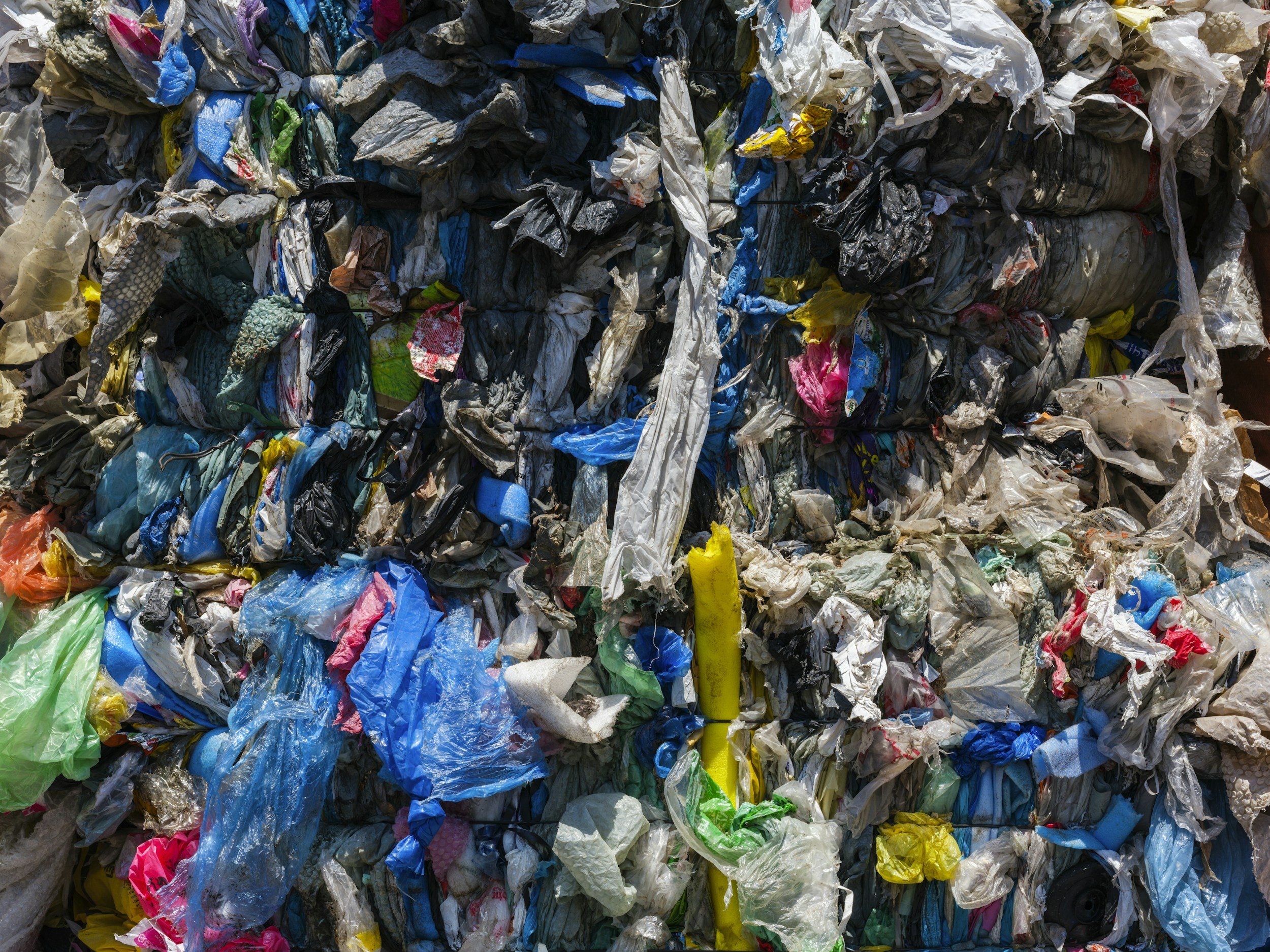
Source Separation of Organics (SSO) is the practice of separating food scraps, yard debris, and other organic materials non-compostable materials at the point where they are generated—such as homes, businesses, institutions, or farms. This creates clean streams of organic materials for compost. Contamination of non-compostable items like plastic, glass, or metal can hinder the composting process, degrade the quality of the final product, and pose risks to soil health, plant growth, and the environment. Common sources of contamination include improper sorting of waste, consumer confusion about compostable materials, and inadequate monitoring during collection and processing.
Explore the videos below to learn more about SSO, preventing contamination, and improving the quality of collected organics.
Many webinars include downloadable resources and links to more information.

It’s been 10 years since the onset of the Act 148 Disposal Ban and many folks are coming up with creative ways to comply! This VORS 2024 session looks at the work that solid waste management entities (SWMEs) have undertaken to support organics diversion from small businesses and includes discussion with participants about their observations, successes, and challenges.
It’s been 10 years since the onset of the Act 148 Disposal Ban and many folks are coming up with creative ways to comply! This VORS 2024 session looks at the work that solid waste management entities (SWMEs) have undertaken to support organics diversion from small businesses and includes discussion with participants about their observations, successes, and challenges.
Celebrate the steps taken by businesses and learn how propping up and promoting the good deeds being done in your community today will help others understand their options for smart diversion for the future and to realize that there are many ways to successfully divert organics for higher and better uses.
Presenter: Alex Lacy, Windham Solid Waste Management District
Video time stamps:
Resources shared:

Recently, there have been many concerns raised over contaminants in compost. This VORS 2023 session provided a conversation with industry experts who discussed and answered questions on possibilities for best management for some of these more challenging organic waste streams.
Recently, there have been many concerns raised over contaminants in compost. Physical and chemical inputs have industry professionals and citizens alike concerned about what we may be putting on our soils. Across the nation, policy is following those concerns. Whether it's PFAS, biosolids, microplastics, or trash, the spotlight is on preventing or reducing, and managing all of it.
This VORS 2023 session provided a conversation with industry experts who discussed and answered questions on possibilities for best management for some of these more challenging organic waste streams. Questions considered:
What do we collectively do with problematic organic wastes?
Where can they be reasonably used?
What's happening upstream to try to make these organic residuals safer? What are the opportunities and limitations?
Panelists:
Andrew Carpenter, Northern Tilth, LLC
Josh Kelly, ANR DEC
Eamon Twohig, ANR DEC
Josh Tyler, CSWD
Facilitator: Natasha Duarte, CAV
Video time stamps:
00:00 VORS introduction from Natasha Duarte
2:41 Introduction to the topic, Natasha Duarte, CAV
7:09 Introduction of panelists
10:28 Opening remarks from Andrew Carpenter, Northern Tilth, LLC
16:33 Opening remarks from Josh Kelly, ANR DEC
20:50 Opening remarks from Eamon Twohig, ANR DEC
26:42 Opening remarks from Dan Goossen, CSWD
31:36 Discussion
1:16:16 Closing comments from panelists
Shared resources:
VT State Law that will ban PFAS in food packaging
As of July 1, 2023 "(a) A manufacturer, supplier, or distributor shall not manufacture, sell, offer for sale, distribute for sale, or distribute for use in this State a food package to which PFAS have been intentionally added and are present in any amount."
CAV’s Compost Conversation PFAS and how these "forever chemicals" impact the composting industry (25 August 2022)
US Center for Disease Control (CDC). National Report on Human Exposure to Environmental Chemicals.

Municipal composting programs are continuously evolving to address challenges and expand capacity. This VORS 2025 session will feature updates from two solid waste management districts tackling key issues in organics recycling.
Municipal composting programs are continuously evolving to address challenges and expand capacity. This VORS 2025 session will feature updates from two solid waste management districts tackling key issues in organics recycling.
Chittenden Solid Waste District’s Organics Recycling Facility will share strategies for controlling contamination in municipal composting, including policy development, equipment solutions, and communication tactics to improve hauler compliance and overall program success.
Windham Solid Waste Management District will provide an inside look at the planning, funding, and construction of their new compost aeration system, designed to increase processing capacity and efficiency. Join this session to learn from real-world experiences, gain insights into innovative solutions, and explore the future of municipal composting operations.
Facilitator: Alyssa Eiklor, ANR/DEC
Panelists and Video time stamps:
0:00-38:00 Kim Stacey and Allison Smith, Chittenden Solid Waste District-Organics Recycling Facility
Strategies for Contamination Control in Modern Municipal Composting
Join Chittenden Solid Waste District’s Organic Recycling Facility home of Green Mountain Compost in covering one of the most persistent challenges in composting: contamination. Topics to be covered include: the process of building, implementing, troubleshooting a new contamination policy; innovative equipment solutions for efficiency; communication strategies to improve relationships and compliance with haulers and a refreshed dedication to curbing an industry wide problem grounded in collaboration, transparency, and continuous improvement. GMC’s efforts have yielded early results, but challenges remain. This session will share practical strategies and lessons learned in a large-scale municipal facility.
38:00-1:30:39 Brian Jerose, Agrilab Technologies Inc. and Robert Spencer, Windham Solid Waste Management District
Installation of a compost aeration system at Windham Solid Waste Management District
WSWMD serves 17 member municipalities in southeastern Vermont, and operates a recycling center, transfer station and composting facility in Brattleboro. Growth of the food scraps and other residuals collected and composted at the site required the district to obtain a new state permit for more capacity, and invest in facility infrastructure. With funding from the district board, the state of Vermont and the USDA Rural Development Community Facilities program, site work began in October 2024 and is nearing completion as of this submission. The presentation will document the phases of design and development, construction, implementation and pending start-up of the compost aeration facility.

This is a recorded Compost Conversation with guests Bob Spencer (WSWMD) and Ben Gauthier (ANR/DEC). August 25, 2022.
This is a recorded Compost Conversation about PFAS and how these "forever chemicals" impact the composting industry, with guests Bob Spencer (WSWMD) and Ben Gauthier (ANR/DEC). August 25, 2022.
Video time stamps:
0:00-7:20 Natasha Duarte, CAV
7:20-14:47 Bob Spencer, WSWMD
14:47-25:52 Ben Gauthier, ANR/DEC
25:52-1:01:48 Discussion
Links to resources gathered for CAV’s Compost Conversation about PFAS and the composting industry (Resources updated on September 8, 2022)
DOWNLOAD A PDF OF THESE RESOURCES
Note: some of the links in the pdf may be broken, please refer to the below list for updated links.
VORS 2020 webinar recording Contaminants of Emerging Concern: Implications for Compost Quality, Use, & Marketing (Andrew Carpenter, starting at minute 44:32)
US Composting Council’s PFAS page
2021 VT PFAS in food packaging legislation (Act 36/S20, Section 2, starting on page 6)
VT ANR/DEC PFAS page and VT PFAS Roadmap (both more general)
Maine DEP's effort to identify all of the incoming pathways of products that may contain PFAS
CEH Single-Use Foodware Public Database (last updated 12-15-2021)
BioCycle PFAS-related articles (several)
Links to information about the closure of Mass Natural Fertilizer by MassDEP:
Black Earth Compost's compost test data and Mass. soil standards
An email from KAS to Bob Spencer about PFAS testing in VT
This email includes a link to Pace Analytical (testing & analytical lab services) that has some comprehensive information and further resources about PFAS
'Forever chemicals' destroyed by simple new method (from phys.org)
Related: How to destroy ‘forever chemicals’: cheap method breaks down PFAS (from nature.com)
New advisory from the EPA effectively eliminates any safe level of PFAS found in water
John Oliver/Last Week Tonight on PFAS - WARNING - John Oliver may offend some folks with profanity. View at your own discretion.

In this VORS 2020 webinar, the panel shares the latest research about contamination concerns for ensuring compost quality, including PFAS, persistent herbicides, and microplastics.
In this VORS 2020 webinar, the panel shares the latest research about contamination concerns for ensuring compost quality, including PFAS, persistent herbicides, and microplastics.
What are the sources of these contaminants? What do we need to know as composters? Are there different implications for different compost end-uses?
Listen to this recorded webinar to learn what we know, what we don’t know, and what relevant research is currently underway.
Panelists:
Andrew Carpenter, Northern Tilth
Ned Beecher, NEBRA
Deb Neher, Department of Plant and Soil Science, UVM
Video time stamps:
Deb Neher on Pathogens, Antibiotics & Antibiotic Resistance: 1:39
Ned Beecher: 20:08 (slide deck)
Andrew Carpenter: 44:32 (slide deck)
Deb Neher: 1:06:49 (slide deck)
Q&A 1:12:38

This engaging and informative VORS 2024 roundtable discussion focuses on the complex issue of PFAS contamination within organics management.
This engaging and informative VORS 2024 roundtable discussion focuses on the complex issue of PFAS contamination within organics management. Listen in as our panelists, comprised of professionals actively addressing PFAS concerns, share their experiences with each other and the audience.
Whether you're a waste management professional, environmental scientist, policymaker, or concerned citizen, this roundtable offers a unique opportunity to learn from seasoned professionals, engage in dialogue, and pose your burning questions regarding PFAS contamination and its implications for organic waste handling.
Facilitator: Dan Goossen
Panelists:
Pam Bryer, VAAFM
Andrew Carpenter, Northern Tilth
Caleb Goossen, MOFGA
Eamon Twohig, VT ANR DEC

Denmark has a long legacy as an agricultural producer and exporter, with a strong national interest in maintaining healthy soil and clean water. The webinar provides an overview of the multi-faceted policy framework that has been put in place over the last 20 years to allow for continued growth of the agriculture sector with a decreasing environmental footprint.
Denmark has a long legacy as an agricultural producer and exporter, with a strong national interest in maintaining healthy soil and clean water. The capture and use of nutrients in food waste and animal manure is on the rise especially over the last several years with the growth of centralized large-scale anaerobic digester (AD) facilities.
As communities in Denmark look to divert more food waste from incineration, the production of ‘bio-pulp’ for delivery to AD plants for renewable energy and fertilizer production continues to grow. The quality controls and regulations around digestate use on croplands in Denmark has led to development of systems designed to limit contamination. These could serve as a model for the numerous de-packaging systems that have been deployed in the US.
The webinar provides an overview of the multi-faceted policy framework that has been put in place over the last 20 years to allow for continued growth of the agriculture sector with a decreasing environmental footprint.
This webinar was part of CAV’s ICAW 2020 program.
Panelists:
Bob Spencer, Windham Solid Waste Management District
Claus Mortensen, Agro Business Park
Dr. Rasmus Eisted, Circular Economy and Waste Management, Danish Environmental Protection Agency
Lars Ravn Nielsen, Gemidan Ecogi A/S
Moderator: Chris Voell, Senior Commercial Advisor at the Embassy of Denmark in Washington, DC, where he was heading the Waste, Recycling & Biogas Advisory.
Video time stamps:
0:00-2:54 Intro to CAV/ICAW
2:54- 8:26 Intro to webinar
8:26-20:18 Bob Spencer
20:18-36:39 Claus Mortensen
36:39-54:57 Dr. Rasmus Eisted
54:57-1:10:53 Lars Nielsen
1:10:53-1:25:08 Q&A
Slide decks from our panelists:

This VORS 2023 session covered the important part haulers play in screening source-separated food residuals, identified policies, tools, and resources for haulers to utilize with customers, and empowered haulers to play an engaged role.
We all know Vermont’s food waste recycling goals rely on haulers to transport materials from generators to destination facilities. Often overshadowed is the critical role haulers play in assuring the cleanliness and purity of organics entering the recycling system.
This VPRS 2023 session covered the important part haulers play in screening source-separated food residuals, identified policies, tools, and resources for haulers to utilize with customers, and empowered haulers to play an engaged role.
Q&A was encouraged and welcome. There was also time during this session for haulers to share their challenges and solutions for hauling food scraps and to learn from each other.
Presenters: Josh Kelly and Ben Gauthier, ANR/DEC
Video time stamps:
00:00 Welcome to VORS 2023 from Natasha Duarte
2:45 Josh Kelly, ANR/DEC
3:30 Ben Gauthier, ANR/DEC
9:42 Josh Kelly, ANR/DEC
13:32 Shared resources
21:17 Q&A and discussion
36:30 More shared resources
39:39 Continued Q&A and discussion
46:30 Materials Management Map
49:04 Continued Q&A and discussion
Download all of the below resources (pdf)
Resources shared regarding Hauling
Universal Recycling Symbols, Bin Signage and other open source graphic files
Materials Management Map (Interactive map with locations and details for Donation, Generators, Composters/ADs, Transfer Stations)
VT Food Scrap Hauler list (slightly outdated, we’ll update soon!)
Resources that haulers can hand out to customers:
Frequently Asked Questions handouts for residents, businesses & institutions, landlords, condo associations, and resorts, hotels, and other lodging establishments

This VORS 2023 presentation provided an update on results from the recent studies in Vermont aimed at quantifying microplastic contamination in composts, digestates, and food wastes.
This VORS 2023 presentation shared results from recent Vermont studies measuring microplastic contamination in composts, digestates, and food wastes. These findings were placed in context with a broader literature review. The presentation also examined measurement methodologies and outlined a roadmap for connecting science and policy to ensure the benefits of food waste diversion are realized while minimizing the risks of microplastic pollution.
Presenters: Kate Porterfield and Sarah Hobson, UVM
Video time stamps:
00:00 Welcome to VORS 2023 from Natasha Duarte
3:44 Project background
21:42 Research questions
23:27 Methods
28:25 Results & Implications
51:57 Q&A
Download the Microplastics in composts, digestates, and food wastes slide deck (pdf)
Resource shared:
VT depackager stakeholder group webpage, including their report of recommendations and associated files

This VORS 2021 webinar examines the trade-offs of different food packaging and service ware options and highlights strategies that individuals, institutions, and policymakers can use to make informed choices that support both sustainability and everyday needs.
Vermont and its communities have long pursued progressive approaches to solid waste management, aiming to make choices with the least environmental impact. But decisions about which materials to use—whether compostables, single-use disposables, or long-lasting durables—require balancing environmental benefit, functionality, practicality, convenience, and cost.
This VORS 2021 webinar examines these trade-offs and highlights strategies that individuals, institutions, and policymakers can use to make informed choices that support both sustainability and everyday needs.
Presenters and Video time stamps:
Dan Goossen starts at 3:22
Marissa Watson starts at 25:35
Marina McCoy starts at 47:25
Q&A starts at 1:10:05

Public and private organizations are often tasked with implementing programs and outreach campaigns to promote environmentally responsible behaviors. This VORS 2022 presentation provides an overview of the steps of community-based social marketing along with illustrative case studies demonstrating its efficacy in fostering behavior change.
Public and private organizations are often tasked with implementing programs and outreach campaigns to promote environmentally responsible behaviors. These programs are typically developed to address an identified problem or meet an adopted policy or mandate. Without exception, the success of these programs hinges on community participation. Achieving change in a designated outcome (e.g., organics diversion) requires behavior change on the part of individuals.
Typically, outreach campaigns aim to promote behavior change by raising awareness and educating the community about the program and the problem it addresses. Although these information-based campaigns can positively increase knowledge attitudes about a specific behavior or problem, they are largely ineffective at creating lasting changes in behavior.
In recent years, community-based social marketing (CBSM) has emerged as an effective approach for developing, implementing, and revitalizing environmental programs. Unlike traditional information-based campaigns, CBSM is an evidence-based process that leverages established psychological principles to remove barriers, increase motivation, and ultimately change behavior.
This VORS 2022 presentation provides an overview of the steps of community-based social marketing along with illustrative case studies demonstrating its efficacy in fostering behavior change.
Presenters and Video time stamps:

Achieving clean organics streams is challenging, especially when a ban pushes us to engage whole communities in separation. In this VORS 2022 session we heard experiences from two panelists, who believe in and are committed to clean streams of organics for producing quality compost, protecting soil and ecological health, and stopping climate change.
Achieving clean organics streams is challenging, especially when a ban pushes us to engage whole communities in separation. Getting individuals, businesses, and institutions to do a good job separating organics from non-compostable materials can be daunting.
Often the collective narrative reflects the idea that effective source separation is impossible because people 'just won't learn' or 'just don't care.' And yet, there are great examples of successful, community-wide, long-term programs that achieve exceptionally high rates of separation.
The key: recognize source separation as a change in behavior and support it as such. When source separation of organics is framed as simply following guidelines, without helping people understand the “why” behind it, we fail to acknowledge human psychology, how decision-making works in the brain, and the various cultural myths we need to resolve in order to successfully engage participants. However, haulers and composters who prioritize the human side of outreach and education, and build these into their programs as iterative processes, have achieved success!
In this VORS 2022 session we heard experiences from two panelists, who believe in and are committed to clean streams of organics for producing quality compost, protecting soil and ecological health, and stopping climate change.
Panelists and Video time stamps:
00:00 Introduction by Natasha Duarte
03:37 Dan Israel, Compost Crew (download a pdf of Dan’s slides)
28:25 Tom Gilbert, Black Dirt Farm (download a pdf of Tom’s slides)
01:04:31 Q&A and discussion

Waste diverters, soil enthusiasts, and green-minded citizens all share a desire for waste reduction, clean sorting streams, and healthy soil. While compostable packaging is intended to provide a solution, it can also add uncertainty for the end-user and the composter. Experts from every facet of the compostable packaging subset explored the preconceptions and misconceptions of compostable packaging and cultivated a discussion towards collaborative solutions in this VORS 2022 session.
Waste diverters, soil enthusiasts, and green-minded citizens all share a desire for waste reduction, clean sorting streams, and healthy soil. The sorting process can be confusing. The myriad of materials that we are expected to sort correctly can foster that emotion, making the process unclear, frustrating, and challenging to execute.
While compostable packaging is intended to provide a solution, it can also add uncertainty for the end-user and the composter. Given that the compost packaging market is expected to increase 17% annually between 2020-2027 - what role could compostable serveware play in achieving the goals of stakeholders devoted to a clean sorting stream, reducing and diverting waste, and building healthy soil?
Experts from every facet of the compostable packaging subset unpacked the answer to this question as this VORS 2022 session explored the preconceptions and misconceptions of compostable packaging and cultivated a discussion towards collaborative solutions.
This recording includes the discussions from the three Zoom rooms.
Panelists and Video time stamps:
00:00 VORS Introduction, Natasha Duarte
04:10 Session Introduction, Natasha Duarte, Moderator
16:48 Panelists opening statements:
Ham Gillett, GUVSWMD, So. Windsor/Windham Counties SWMD
Toby Alves, ECO Products
Corey Berman, UVM Recycling & Zero Waste
Zach Cavacas, Music Mountain Compost
Trevor Mance, Casella Waste Systems, Inc.
Elly Ventura, Vegware
Zoom Room 1
Zoom Room 2
Zoom Room 3
1:59:21 Full Group Wrap Up
Shared resources:
A pdf of organized resource links put together for this session
Foodservice Packaging & Composting: Information for Composters (from Foodservice Packaging Institute)
List of compostable products tested to disintegrate in today's systems (from CMA)
Single-Use Foodware Public Database (from Center for Environmental Health; last update: 12-15-2021)

This VORS 2024 Haulers’ Roundtable focuses on sharing tips and tricks for working with customers to ensure effective SSO (source separation of organics). Whether you’re new or established, small or large, clearly identifying expectations, establishing effective channels for communication, and outlining parameters and consequences for contaminated loads are essential to success.
This VORS 2024 Haulers’ Roundtable focuses on sharing tips and tricks for working with customers to ensure effective SSO (source separation of organics). Whether you’re new or established, small or large, clearly identifying expectations, establishing effective channels for communication, and outlining parameters and consequences for contaminated loads are essential to success. In addition to learning from each other, specific requests for support from ANR DEC were also identified.
Facilitator: Tom Gilbert, Black Dirt Farm
Notetaker: Caroline Gordon, Rural Vermont
Video time stamps:
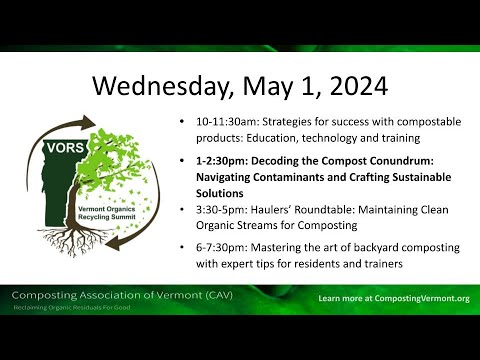
This VORS 2024 panel discussion delves into contaminant concerns in compost, such as persistent herbicides, microplastics, and PFAS. As composting gains momentum with landfill diversion laws, it's crucial to address the potential pitfalls that may compromise its environmental benefits.
This VORS 2024 panel discussion delves into contaminant concerns in compost, such as persistent herbicides, microplastics, and PFAS. As composting gains momentum with landfill diversion laws, it's crucial to address the potential pitfalls that may compromise its environmental benefits.
Our panel of experts discuss the challenges posed by persistent herbicides and offer best practices for those managing materials treated with herbicides; examine the concerns about microplastics from depackaging facilities, and share updates about new technology that has made strides to address these concerns; and consider the threat of PFAS (Per- and Polyfluoroalkyl Substances) in compost, which is increasingly in the "hot seat" due to pressing concerns associated with these persistent chemicals.
This informative session aims to empower participants with the knowledge to make informed decisions about composting practices, promote a more sustainable and contaminant-free approach to organic waste management, and provide valuable insights into the evolving landscape of composting and environmental stewardship.
Panel presentations:
“Persistent herbicides, is that still a thing?” from Pam Bryer, Vermont Agency of Agriculture, Food, & Markets.
“Solutions for removing microplastics from depackaged food organics” from Kevin Pedretti, Scott Equipment
“PFAS in compost - how does it get there and what can be done” from Caleb Goossen, Maine Organic Farmers & Gardeners Association
Video time stamps:
02:26-28:41 Pam Bryer, Vermont Agency of Agriculture, Food, & Markets
Download the slide deck (pdf)
53:54-01:25:26 Caleb Goossen, Maine Organic Farmers & Gardeners Association
Download the slide deck (pdf)
Resources shared:
EPA Registration Review of Pyridine and Pyrimidine Herbicides
VAAFM Registered Products (Brand search)
Pesticide Usage Reported (VAAFM)
PFAS in the US population (ATSDR)
Organofluorine Mass Balance Analysis of Whole Blood Samples in Relation to Gender and Age
Extending the knowledge about PFAS bioaccumulation factors for agricultural plants – A review
Explore the opportunities and challenges of biosolids-based manufactured topsoil with Charley Hanson of Resource Management, Inc. and Josh Burns of Vermont DEC. Learn how residual-derived soil products are made, regulated, and used to rebuild soils, control erosion, restore disturbed landscapes, and support beneficial reuse—while addressing concerns such as product quality and PFAS.
What role could biosolids-based manufactured topsoil play in rebuilding soils, restoring disturbed landscapes, and managing residual materials in Vermont and across the Northeast?
In this webinar, Charley Hanson of Resource Management, Inc. and Josh Burns of the Vermont DEC Residuals Management & Emerging Contaminants Program discuss manufactured topsoil made from residual materials such as biosolids, paper fiber, wood ash, and mineral soils.
The conversation covers how these engineered soil blends are produced, tested, regulated, and used in applications including land reclamation, roadside stabilization, gravel pit restoration, landscaping, erosion control, and stormwater management.
The presenters also explore some of the opportunities and challenges surrounding beneficial reuse of residual materials, including product quality, regulatory oversight, public perception, environmental and public health protections, and emerging contaminants such as PFAS.
This webinar offers a practical look at where residual-derived soil products may fit within broader efforts to rebuild soils, restore disturbed landscapes, improve climate resilience, and advance more circular approaches to materials management.
0:00-2:30 - Natasha Duarte, CAV
2:30-22:09 - Charley Hanson — Resource Management, Inc.
22:09-27:30 - Josh Burns — Vermont DEC Residuals Management & Emerging Contaminants Program
27:30-37:20 - Charley Hanson — Resource Management, Inc
37:20-55:46 - Q&A and discussion